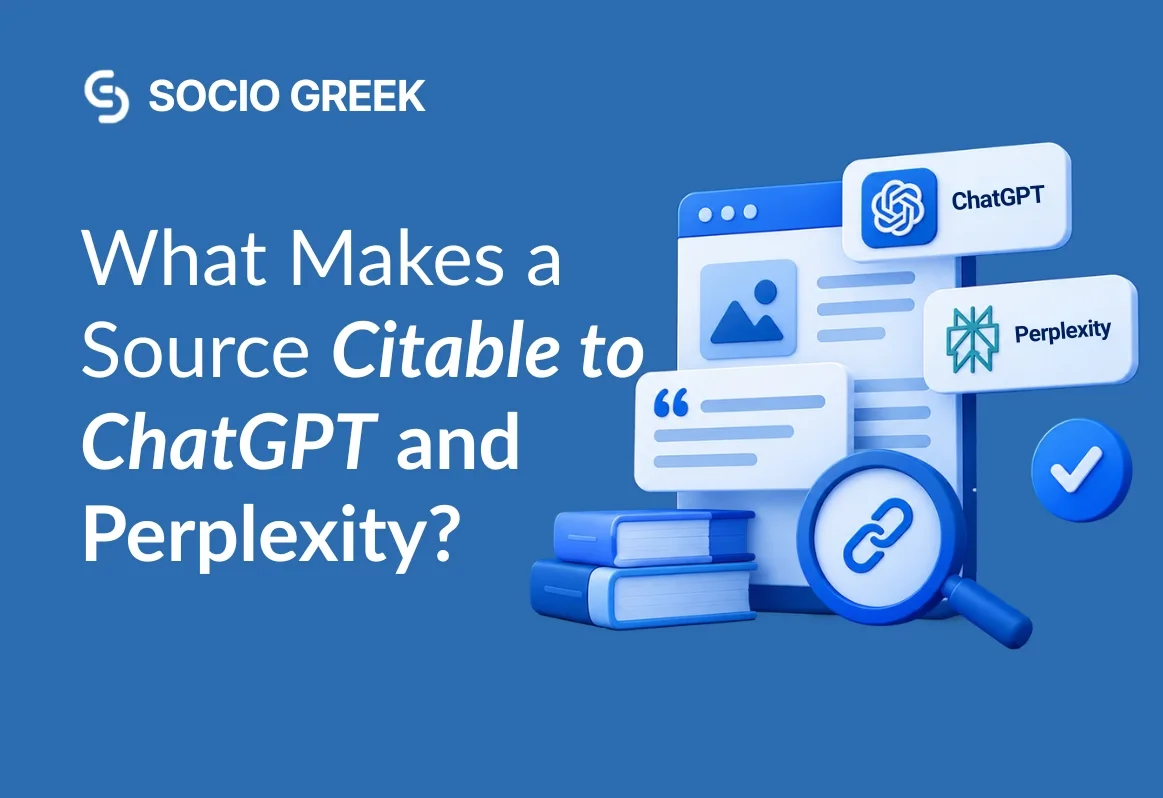
Users increasingly use ChatGPT and Perplexity to compare services, conduct product research, and make decisions. These services often support their responses by linking to the sources they used, giving businesses a chance to improve their visibility.
Publishing a blog does not automatically make it citable. AI search systems must find the page, understand it, and consider it useful for a specific question.
For businesses researching how to get cited by AI search engines, the goal is to create accessible, clear, accurate, and well-supported content that answers real queries.
What Does “Citable” Mean in AI Search?
A citable source is a page an AI search system can use as evidence for a fact, definition, comparison, statistic, or explanation.
Citation differs from traditional organic ranking. A page may be selected because one section closely answers the question, provides original information, or adds evidence other sources lack.
There is no permanent “approved source” status. Choices can change with the query, location, available sources, and freshness of information.
1. The Page Must Be Accessible to AI Search Crawlers
Content cannot become a reliable search source if the relevant system cannot access it.
OpenAI states that OAI-SearchBot is used to surface websites in ChatGPT search. Sites that opt out will not appear in ChatGPT search answers, although they may still appear as navigational links. OpenAI recommends allowing the crawler in robots.txt and permitting requests from its published IP ranges.
Perplexity gives similar guidance for PerplexityBot. Websites using a firewall may also need to allow verified bot requests.
Important pages should also return a successful status code, work without a login, load meaningful HTML content, avoid accidental noindex instructions and use the correct canonical URL.
Crawler access creates eligibility, not a citation guarantee.
2. The Content Should Answer a Clear Question
Pages become easier to use when they have a defined purpose. A broad article covering many loosely related ideas can make it difficult for a search system to identify the most relevant passage.
Each important page should address a clear search intent. The answer has to be made obvious at the beginning, then followed by useful details. It is also recommended that headings, short paragraphs, tables, lists, and definitions are used for improved comprehension by readers and retrieval systems.
This does not mean reducing every article to short answers. It means giving each section a clear job.
3. Claims Need Verifiable Evidence
Perplexity describes its search experience as delivering cited answers with access to referenced sources. ChatGPT search can also include source links alongside claims.
Content is more useful as a reference when important statements can be verified. Writers should link statistics to the original study, name the organisation behind the data, include the publication date, and explain how any calculation was made.
Avoid phrases such as “research proves” when no study is identified. For an internal survey, explain the sample, period, location, and method.
4. Original Information Creates Citation Value
Simply rephrasing information that has already been spread on many websites will not warrant the selection of the new website by an AI search engine. One could create an original piece of information by gathering statistics from customers, conducting a survey, describing a tested method, quoting an expert, writing about a detailed case study, or creating a comparison based on conditions already mentioned. A practical case is also a good thing to provide in an article to show how the customer’s idea works in practice.
It is also possible to publish anonymized trends, customer requests, findings of the processes used, or observations.
5. Expertise and Transparency Strengthen Trust
Readers should understand who created the content and why they are qualified. Add a genuine author name, relevant experience, a review date, and a clear company profile. Expert review is especially important for health, finance, and law.
Transparency matters inside the article as well. Separate facts from opinions, disclose commercial relationships, and mention important limitations. Strong claims without context may attract attention, but they do not create a dependable reference.
6. Freshness Must Match the Topic
Software instructions, prices, regulations, product features and statistics can become outdated quickly, although evergreen definitions may remain useful for years.
Review time-sensitive content regularly. Replace old figures, repair broken links and show the latest meaningful update date. Changing only the date does not make a page fresh.
7. Consistent Brand Information Reduces Confusion
AI systems may find company information across websites, business profiles, media coverage, directories and discussions. Conflicting descriptions create confusion.
Keep the company name, service details, leadership information, locations and important claims consistent. Use clear About, Contact, author and service pages. Structured data can help identify page elements and entities, but it cannot rescue thin or inaccurate content.
Independent mentions add context when credible publications describe an organisation accurately. They should be earned through useful work, expert contributions, research, and legitimate media activity.
How to Generate Citations in AI Search

No submission button forces ChatGPT or Perplexity to cite a page. A practical process is to:
- Check access for OAI-SearchBot and PerplexityBot.
- Fix indexing, canonical, rendering, firewall and status-code issues.
- Map real audience questions to focused pages or sections.
- Place a direct, accurate answer near the start of each section.
- Support claims with original or primary evidence.
- Add authorship, dates, methodology and useful source links.
- Monitor citations across a repeatable set of relevant prompts.
- Update pages when facts, products, or user needs change.
Some people search for ways to get cited by AI search engines for free. The essential work does not require paying an AI platform. Businesses can allow crawlers, improve pages, publish original knowledge and test relevant prompts. The real investment is research, writing, technical checks, and measurement.
Using AI for References and Citation Work
Using AI for references and citation research can support topic discovery, source comparison, and the identification of claims that need evidence.
Human verification remains important. AI-created references may be insufficient, obsolete, or incorrectly associated with a statement. Writers should read each reference and check that it substantiates the relevant claim, favour primary evidence, and make a note of the publisher and date.
How Socio Greek Supports AI Citation Readiness
Socio Greek helps brands assess how their information appears across AI search. Its work includes AI visibility audits, crawler checks, content gap analysis, entity consistency, digital PR, brand monitoring, and citation tracking.
The process checks technical access, content quality, and whether important pages answer real customer questions. Recommendations address measurable gaps rather than promising guaranteed citations.
Conclusion
A citable source is accessible, relevant, evidence-based, current, and transparent. Formatting helps extraction, but substance matters more.
Brands learning how to get cited by AI search engines should focus on becoming a dependable source within their field. When useful information is supported by real expertise and made easy to find, the likelihood of earning citations improves across ChatGPT, Perplexity, and other answer-led search experiences.