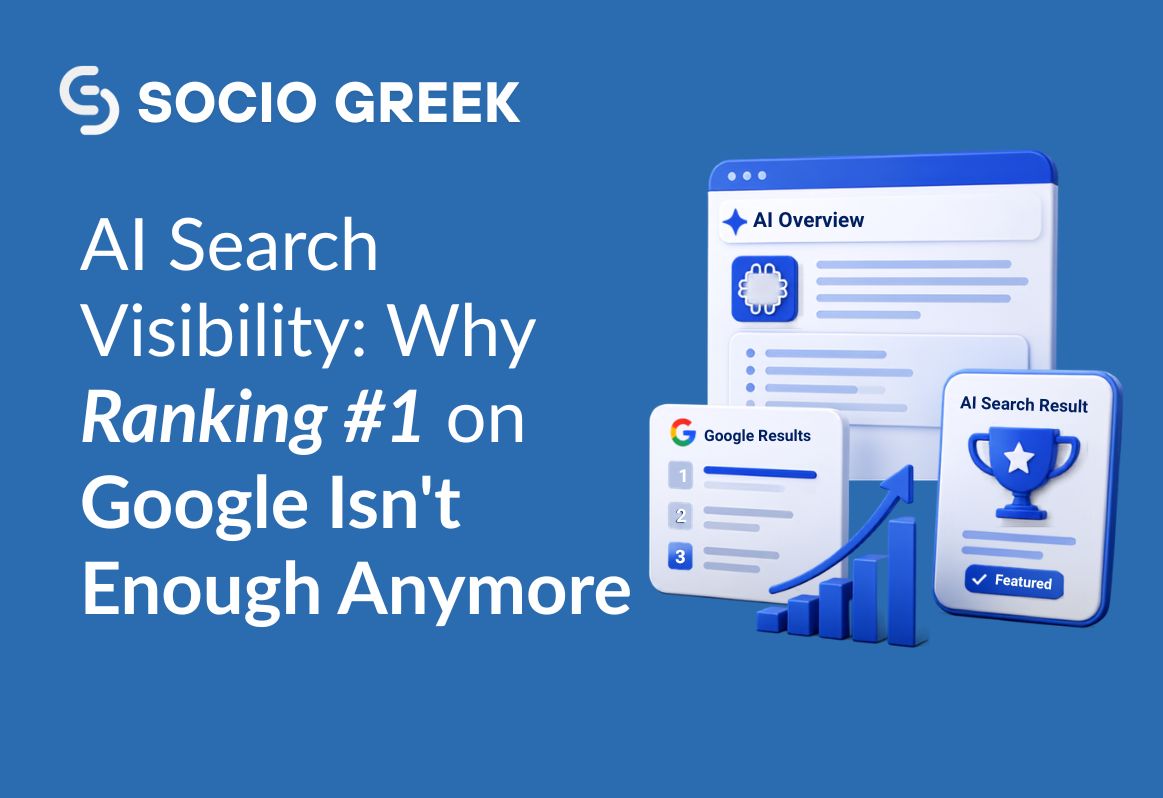
The number one objective for years had been to be #1 on google and that traffic would follow. That playbook is still important but no longer all the game. Today, millions of people are using ChatGPT to make product recommendations, using Perplexity instead of searching with a blue link, and using Google’s AI Overviews to get their answer before even scrolling to a blue link. Whether your brand ranks high in traditional search or not, if it doesn’t appear in those AI-generated responses, it’s as if it’s not there for a significant portion of your audience. Now is the new reality of the AI search visibility landscape and it’s changing the way brands must think about discoverability.
What Is AI Search Visibility, Really?
AI search visibility is how often, and how accurately, your brand shows up when someone asks an AI system a question related to your industry. This encompasses AI Overviews by Google, ChatGPT, Perplexity, Claude and Gemini. AI visibility differs from the traditional SEO approach, where you’re bidding for a position on a search results page, because it’s the opportunity to be cited, quoted, or recommended within a generated response. There isn’t another page in here either, the AI talks about you or not.
This change is important because the tools don’t automatically crawl your homepage and stop there. They draw from a much broader network of sources, your website, but also Reddit threads, review sites, comparison articles, forums and other UGC that references your brand. It is for this reason that UGC real conversations, honest reviews and community discussions has become a vital indicator for AI models dealing with identifying trustworthy, citable content.
Why #1 on Google Doesn’t Cut It Anymore
Ranking first used to guarantee visibility. In recent years, more and more of these searches are now done without any clicks, as the AI Overview or chatbot answer already met the query. A brand may be the No.1 in the organic results, but it will still not appear in the AI-generated summary and other content above it. Even worse: A smaller competitor that ranks better, mentions more third parties and has a better topical authority can be cited, even if it doesn’t show up in the rankings.
That is why agencies, including Socio Greek, that are concerned with how to improve brand visibility in ai search engines from simply ranking for keywords to answer-readiness: can an AI lift your content, understand it, and trust it enough to quote it?
The Metrics That Actually Matter Now
While traditional metrics, such as rankings and organic clicks, aren’t the end of the story, they don’t tell the whole story anymore. For brands and agencies, the AI search visibility metrics KPIs to be monitored are:
Citation frequency – The number of times your brand or content appears in AI answers and texts across platforms such as ChatGPT and Perplexity.Citation frequency (how many times your brand/content is cited in AI-generated answers and texts on various platforms, including ChatGPT and Perplexity).
Share of voice in AI answers – how you compare to competitors when the same query is asked
Sentiment and accuracy of AI mentions – does the AI describe your brand accurately (and favorably)?
Referral traffic from AI platforms – Analytics dashboards are getting a new and growing traffic source
Presence across UGC and third-party sources – AI training and retrieval via presence in UGC and third-party sources
Consistently measuring these will provide more meaningful information on discoverability in the real world than rankings will.
Optimizing for ChatGPT, Perplexity, and Beyond
If you want to genuinely optimize your website for ChatGPT, Perplexity, and AI search visibility overall, the approach looks different from classic on-page SEO. AI models favor content that’s structured, direct, and easy to extract. That means:
- Answer the question in the first two sentences. AI systems search for answers that are clearly stated.
- Use structured data and schema markup to enable machines to more easily process entities, authors and facts without confusion.
- Build topical depth, that is, a series of articles on a topic that will address it from various perspectives.
- Get mentioned beyond your own site. AI models weigh third-party validation heavily, so guest content, PR mentions, and community discussions carry real weight.
- Keep information current and factually consistent as misinformation spread across the web can have a negative impact on trust signals and can be done subtly.
Techniques for Boosting Visibility in AI Search Algorithms
Beyond technical fixes, a few techniques for boosting visibility in AI search algorithms consistently show results:
- Digital PR and organic backlinks from credible, relevant sources that AI models already trust
- Encouraging genuine user-generated content – reviews on platforms like G2, Trustpilot, and Reddit, since these threads are frequently pulled into AI answers as real-world validation
- FAQ-style content blocks that mirror how people naturally phrase questions to AI assistants
- Consistent brand entity signals across Wikipedia-style sources, LinkedIn, and business directories, helping AI models correctly identify who you are
- Regular content audits to remove outdated or conflicting information that could confuse retrieval systems
These are not stand-alone solutions. AI visibility is constructed on the exact same system, your website, your reputation and your community, and does not rely on any single page ranking. At Socio Greek, we’ve witnessed this phenomenon many times with clients brands with a good website who begin to receive third-party and community mentions that then get included in AI responses in a matter of weeks.