Search rules have undergone a sea change. No longer does Google just rank pages and guide users towards them; it now reads, synthesizes and answers the questions directly. AI platforms, such as ChatGPT, Claude and Perplexity take it one step further, providing conversational responses that feature your brand or even go without it entirely. This is exactly the gap that Socio Greek helps brands bridge ensuring your brand is not just present online, but actively recommended by AI. In this guide, you’ll learn how to show up in AI search results, how to monitor your brand mentions across AI models and how to enhance your brand visibility in AI search in the long run.
What Is AI Search Optimization and Why Does It Matter in 2026?
AI Search Optimization (also known as Generative Engine Optimization or GEO) involves optimizing your brand’s content to make it easily found, understood, trusted, and recommended in LLM output.
The key distinction from standard SEO is that you’re not targeting a ranking place, but rather an AI-generated reply.
Key Takeaway: A small software company could show up on page three of Google for the term “project management tools” but always be included in the results when users ask ChatGPT for project management tools.
The reason? AI platforms evaluate entirely different signals than search engines. Understanding these signals is the foundation of LLM SEO and AI Answer Engine Optimization.
The Numbers You Can't Ignore in 2026
Metric | Data Point |
Searches ending without a click | 60% |
Drop in position-1 CTR due to AI Overviews | 58% (Ahrefs) |
Higher conversion rate of AI-referred traffic vs. organic | 23x |
Growth in global search volume despite AI disruption | 0.26 |
The message is clear: AI-referred traffic is fewer in volume but dramatically higher in intent. Getting your brand into AI answers is no longer optional it’s a competitive advantage.
Understanding How LLMs Decide Which Brands to Cite
Before you can get your brand into AI answers, you need to understand how LLMs select their sources. AI models don’t crawl the web in real time the way Google does. They draw from:
- Pre-training data – content they absorbed during model training
- Retrieval-Augmented Generation (RAG) – live retrieval from trusted web sources
- Third-party platform content – forums, review sites, publications, and social platforms
LLMs prioritize content that is:
- Structured: headers, bullets and defined sections (clarly organized)
- Explainable – factual, specific and without jargon
- Trustworthy – citations, author credibility and consistent E-E-A-T signals
The difference between being cited versus being skipped is determined by this framework: Structure, Explainability, Trustworthiness (SET).
8 Proven Strategies to Get Featured on AI Platforms
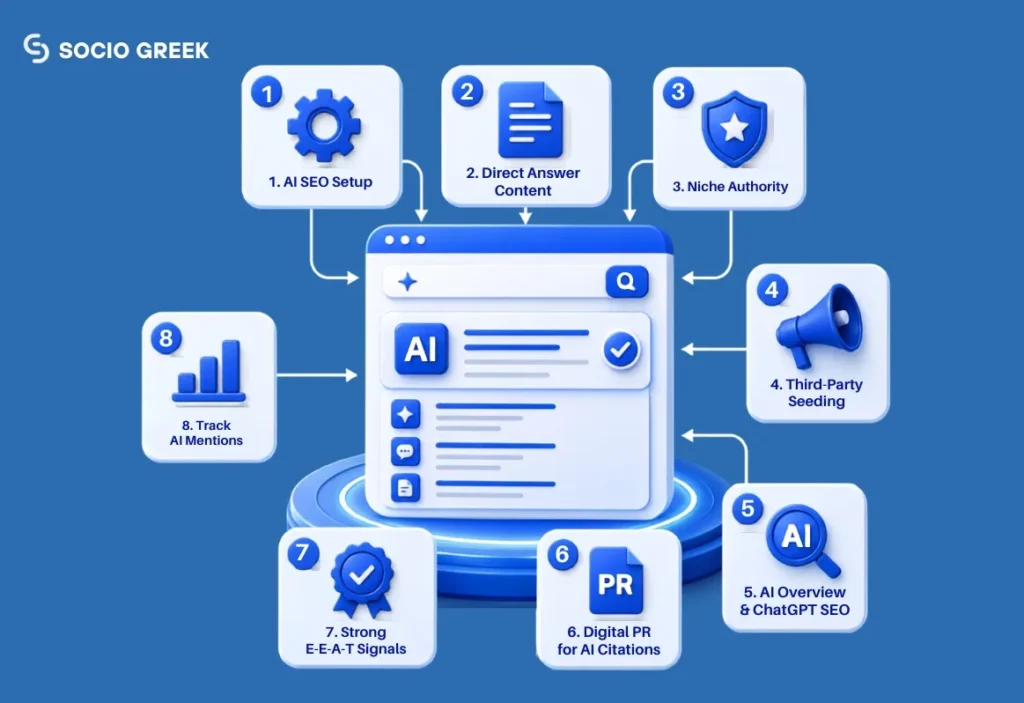
1. Meet the AI Search Optimization Setup Requirements
Before anything else, your technical foundation must support AI crawlability. These are the ai search optimization setup requirements every brand must address:
- Make sure your sitemap is current and that AI crawlers such as GPTBot, ClaudeBot and Google’s updated crawlers can access it.
- Make sure that schema markup (Organization, Product, FAQ, HowTo, Article) is used to allow for structured data being parsed by LLM’s.
- Don’t use JavaScript to render your content so that AI bots can’t use it.
- Craft clear and informative Meta Descriptions – sometimes AI summaries are directly generated from Meta Descriptions.
- Ensure robots.txt is reviewed – many brands are unwittingly blocking AI crawlers.
Pro Tip: AI models tend to have a problem with complex navigation, login walls or pop-ups. Prioritise the content and make it easy to access.
2. Create Content That Answers Questions Directly (AEO)
The first step to developing optimized content for AI Answer Engines is to write content the way the LLM will consume it: answer first, detail second.
All content should begin with a straightforward and concise answer to the users’ query, followed by supporting detail. This is as it is when LLM’s respond to your query and means that you are more likely to be cited.
Content formats LLMs favor most:
- FAQs with clear question-and-answer pairs
- Numbered “how-to” guides
- Comparison tables (e.g., “X vs Y”)
- Definition-led paragraphs
- Listicles and ranked lists
- Statistics with cited sources
According to research from Evertune, 50% of ChatGPT citations are listicles, with ranked lists making up 58% of those. The median cited page contains around 941 words, 4 H2 headings, and 15 external links giving you a clear content blueprint to follow.
3. Build Topical Authority Across Your Entire Niche
One of the strongest ai search optimization signals is topical depth. LLMs trust brands that consistently and comprehensively cover their subject area not brands that publish one blog post and move on.
To build topical authority:
- Create pillar pages that cover your core topic in depth
- Build cluster content around every related subtopic, use case, and question
- Link your content internally to demonstrate topic relationships
- Publish regularly to maintain content freshness – a key factor for RAG-based retrieval
In other words, if you’re marketing HR software, don’t write about “HR software features. Your content should include authoritative information about onboarding, payroll compliance, employee retention, HR analytics, labor laws, and more. The width indicates that your brand is a trustworthy, thorough resource that is worth promoting.
4. Seed Your Brand Across Third-Party Platforms
This is the core principle of LLM seeding and it’s arguably the most important strategy for brands that want to get featured on AI platforms.
LLMs don’t only pull from your website. They collate information from around the internet. The more often your brand is referenced by third-party sources, and the more positive the reviews you hear about, the greater the trust of AI models in recommending your brand.
If you want to get started, you can seek assistance from companies that can assist brands with LLM citations and help expedite the process. The experts are familiar with the platforms that will be best leveraged by various AI models and can guide you through developing a distribution strategy that builds up citation authority systematically.
High-value platforms to seed your brand content on:
Platform Type | Examples |
Professional publishing | LinkedIn Articles, Medium, Substack |
Industry review sites | G2, Capterra, Trustpilot, Clutch |
Q&A communities | Reddit, Quora, Stack Exchange |
Industry publications | Guest posts on niche trade blogs |
Press and news outlets | PR pitches, contributed articles |
Video platforms | YouTube (with detailed transcripts/descriptions) |
The intent is to have a consistent and accurate reputation in the web not only on your website. If many reputable sources state the same thing about your brand, the LLM incorporates that agreement and will be more likely to include your brand name in its response.
5. Optimize for Google AI Overview and ChatGPT SEO
While there are similarities, there are some subtle distinctions between Google AI Overview Optimization and ChatGPT SEO.
For Google AI Overview:
- Consider E-E-A-T (Experience, Expertise, Authoritativeness, Trustworthiness) signals.
- Use structured data and FAQ schema
- Get backlinks from other high-quality websites.
- Communicate in a clear, educational style that Google can summarize
For ChatGPT and other LLMs:
- Write material for indexed platforms (such as big news organizations, or Wikipedia adjacent content).
- Write in clean formatting with proper, citation-ready language
- Get brand mentions in LLM-crawled forums/communities (especially Reddit)
- Make sure your brand description is the same throughout all online platforms.
Shared best practices across all platforms:
- Define your brand clearly what you do, who it’s for, what problem you solve
- Avoid vague marketing language; use specific, factual descriptions
- Include statistics, data points, and third-party validation in your content
6. Leverage Digital PR for AI Citation Optimization
AI Citation Optimization is about more than just publishing great content. It’s about getting authoritative third parties to talk about your brand in a way that LLMs will recognize and repeat.
Digital PR is one of the most powerful tools for this:
- Get featured in “best of” listicles on reputable websites LLMs heavily cite these formats
- Issue press releases that get picked up by news syndication services
- Earn mentions in industry reports and research papers
- Contribute expert quotes to journalist roundups (use tools like HARO/Connectively or Qwoted)
- Win or get listed for industry awards AI models often surface award-listed brands as credible options
Each unlinked mention even without a clickable backlink builds your brand’s presence in the data pool that LLMs train on and retrieve from.
7. Strengthen Your E-E-A-T Signals for LLM Trust
Experience, Expertise, Authoritativeness, and Trustworthiness (E-E-A-T) is more than a Google ranking algorithm; it’s the structure that these LLM’s apply to determine if your brand should be cited.
To strengthen E-E-A-T for AI SEO:
- Author pages with verified credentials, social profiles, and publication history
- About page with clear company background, founding story, and team credentials
- Case studies and real customer results with named clients when possible
- Transparent sourcing – cite your own statistics and link to credible external sources
- Consistent NAP data (Name, Address, Phone) across all platforms for local and entity signals
- Wikipedia or Wikidata presence – being represented in knowledge graph databases significantly increases the likelihood of being recognized as a legitimate entity by LLMs
8. Track and Monitor Your Brand Mentions in AI Search Results
You can’t measure what you can’t improve, and knowing how to do it with AI search results is essential. That’s another reason why it’s important to understand why it matters to monitor brand mentions in AI search results: You might not be visible (or even visible in a negative light) without even realizing it.
How to track brand mentions on LLMs:
- Manual prompting – regularly ask ChatGPT, Gemini, Perplexity, and Claude questions your customers would ask, and note whether your brand appears
- Dedicated GEO/AEO tools – there are several companies helping brands with LLM citations that offer monitoring platforms, running thousands of prompts monthly across multiple LLMs to surface brand visibility data, sentiment scores, and competitive share of voice
- AI referral traffic – monitor your Google Analytics for traffic from AI platforms (ChatGPT, Perplexity, etc.)
- Branded search volume – a rise in branded searches can indicate growing AI-driven awareness even from unlinked citations
Key metrics to track for AI Brand Visibility:
Metric | What It Tells You |
AI citation frequency | How often your brand appears in AI answers |
Share of voice | Your brand vs. competitors in AI responses |
Sentiment analysis | How AI describes your brand (positive/neutral/negative) |
Citation source quality | Which platforms are being cited when your brand appears |
AI referral traffic | Direct visits from LLM-generated links |
Traditional SEO vs. AI Search Optimization: Key Differences
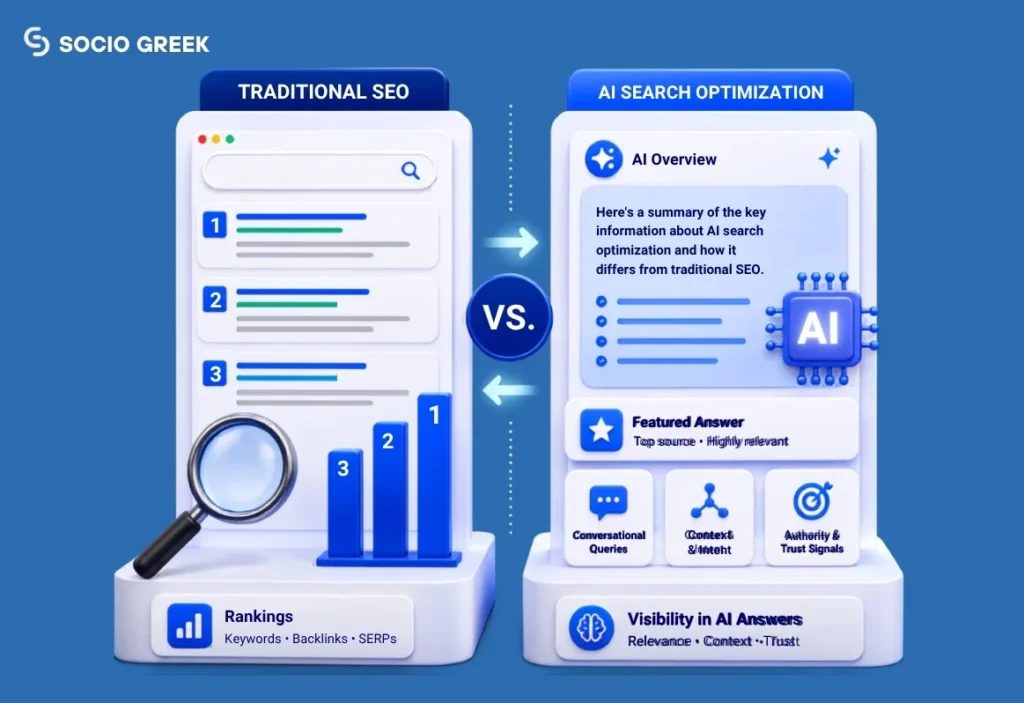
Factor | Traditional SEO | AI Search Optimization (GEO) |
Goal | Rank in search results | Get cited in AI-generated answers |
Success metric | Rankings, CTR, traffic | AI citation frequency, share of voice |
Content format | Keyword-optimized pages | Answer-first, structured, factual content |
Authority signals | Backlinks, domain authority | E-E-A-T, third-party mentions, entity signals |
Distribution | Own website | Own site + distributed across trusted platforms |
Timeline | Weeks to months | Months (pre-training lag applies) |
How to Improve Brand Visibility in AI Search Results: A Checklist
Use this quick-reference checklist to audit your current AI readiness:
Technical Foundation
- AI crawlers are not blocked in robots.txt
- Schema markup (Organization, FAQ, Product) is implemented
- Site loads fast and content is accessible without JavaScript
- Sitemap is current and submitted to major search engines
Content Strategy
- Core pages use answer-first paragraph structure
- FAQ sections are present on key topic pages
- Comparison tables and listicles are included where relevant
- Content covers topics in depth, not just individual keywords
Authority & Trust
- Author credentials are visible and verifiable
- About page reflects real expertise and company background
- Customer case studies are published on the site
- Brand is present and consistent on major review platforms
Distribution & LLM Seeding
- Brand is actively mentioned on Reddit, Quora, and industry forums
- Guest posts and contributed articles have been published on niche sites
- Digital PR efforts are generating third-party brand mentions
- LinkedIn and Medium articles are being published regularly
Monitoring
- Manual AI prompting is done monthly across major LLMs
- AI referral traffic is tracked in analytics
- Branded search volume is being monitored
Final Thoughts: The Brands That Win in AI Search Act Now
Our transition to ranked blue links to AI-generated answers isn’t in the future it’s happening now. Brands who get it how to leverage AI search results will gain one additional advantage after another that will be harder and harder for other brands to catch up with.
The good news is that the playbook is clear:
- Make your content technically accessible to AI crawlers
- Structure content to answer questions directly
- Build genuine topical authority in your niche
- Seed your brand strategically across trusted third-party platforms
- Earn citations through digital PR and E-E-A-T signals
- Monitor your AI presence and optimize continuously
Whether you execute this in-house or partner with companies helping brands with LLM citations who specialize in GEO strategy, the most important step is starting. The brands that are appearing in the responses given by ChatGPT, Gemini, and Perplexity did not just appear because they have a brilliant marketing team.The brands appearing in the ChatGPT, Gemini, and Perplexity answers are not just there because they have a great marketing team.
AI search is not taking the place of traditional SEO, it’s elevating the bar. The brands which come out successful are the ones which consider them as complementary and not competing with each other.
Start with an audit of your AI visibility today. Ask ChatGPT, Gemini, and Perplexity the questions your best customers ask. If your brand isn’t there now you know exactly what to do.
FAQ
What is Generative Engine Optimization (GEO)?
GEO is optimizing your content so AI tools like ChatGPT and Gemini recommend your brand in their answers – beyond just search rankings.
How do I get my brand into AI answers?
Create content that’s structured and answer-driven, establish a presence on trusted third-party platforms, and enhance your E-E-A-T signals.
How do I appear in AI search results like Google AI Overview?
Apply basic SEO principles: make use of FAQ schema, provide good content answers, obtain quality backlinks, maintain crawlability.
How do I track brand mentions on LLMs?
Manually prompt AI tools with customer questions, use AI monitoring platforms, and track AI referral traffic in Google Analytics.
Why you should monitor brand mentions in ai search results
If you don’t monitor, you’ll be unable to determine if AI is suggesting to, ignoring or misrepresenting your brand to high-intent buyers.
Does traditional SEO still matter for AI search?
Yes – Crawlable, authoritative pages are a favorite of AI. Spend 70-80% on basic SEO and 20-30% on AI-driven visibility tactics.
How long does it take to see results from AI search optimization?
RAG-based systems can see improvements within weeks; wider LLM influence: 3-6 months of consistent efforts.