The simple answer of how to improve brand visibility in AI search engines: Make content ready for AI to answer, write topical content that can be cited, acquire citations from reputable sources, and structure information in tables, lists, FAQs for easy extraction and citation by Google AI Overviews, ChatGPT, and Perplexity.
Search activity is evolving. No longer is scrolling through ten blue links expected to get a single answer from an AI assistant. In the brand’s case, it goes far beyond page one ranking; it’s about being the name cited as a source of the AI. Here at Socio Greek, we deal with businesses daily who are trying to solve this issue: How do you remain visible when the “search results page” has become a paragraph that an algorithm wrote?
Below are 11 actionable and practical tips to improve visibility within AI search algorithms from content structure to technical SEO.
How AI Search Engines Actually Choose an Answer
Before the list, it helps to understand the basic decision flow AI systems use when picking a source to cite:
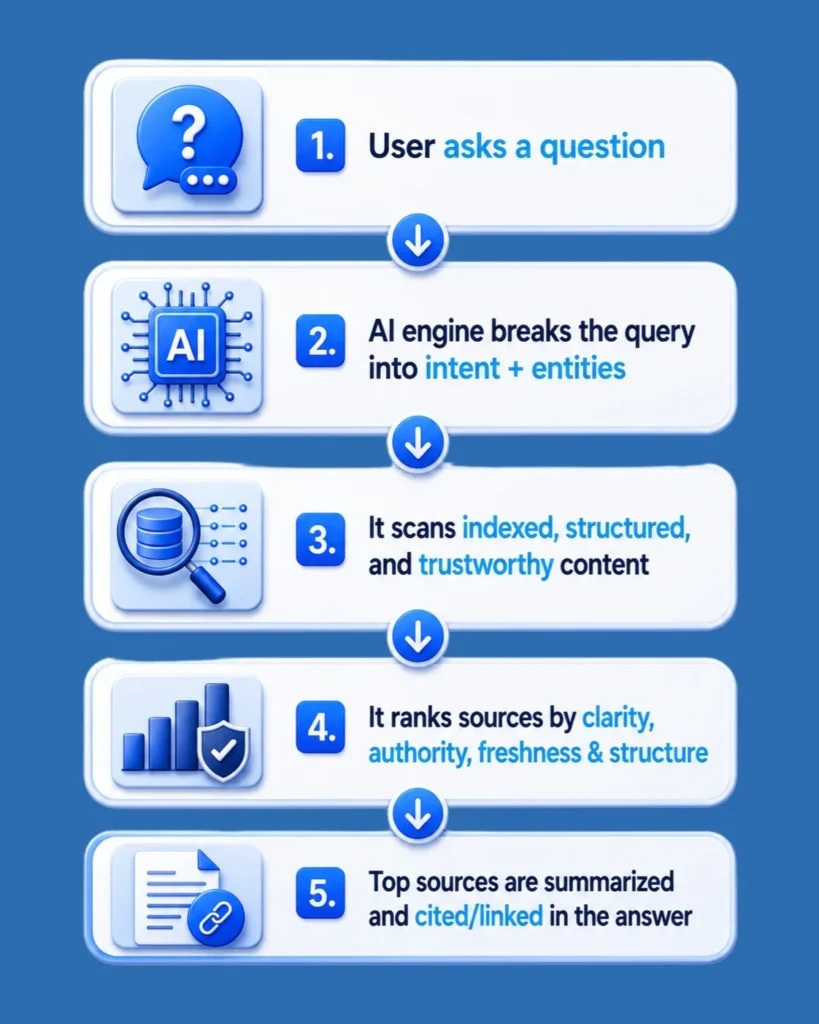
Every one of the 11 strategies below is designed to move your content further along this pipeline.
1. Lead With a Direct Answer (Answer-First Writing)
Give a clear, stand-alone answer, 100-150 words, to the prompt for the specific question. Typically, AI engines and featured snippets appear with the first sentences of a webpage, so it’s advisable to avoid a lengthy introduction and write the answer instead.
2. Structure Content for Machine Readability
This is one of the most effective techniques for boosting visibility in AI search algorithms. AI models parse structured content far more reliably than dense paragraphs.
- Clear H2/H3 headings in the form of questions
- Divide processes into logical steps with numbers.
- Use tables for comparisons or data
- Keep paragraphs short (2-4 sentences)
3. Build Topical Authority With Entity-First Content
AI models identify your brand as an “entity” before evaluating keyword relevance. Organize content around clearly defined concepts, products, and use-cases – not just keyword strings – so your brand is recognized as an authority in its category.
4. Use Structured Data and Schema Markup
Context can be understood in real-time by AI crawlers via the schema markup (FAQ, Article, Organization, Product, HowTo). This is one of the basic elements of artificial intelligence search engine optimization as it helps the AI bots understand your page.
Schema Type | Best Used For |
FAQPage | Question-based content, help articles |
HowTo | Step-by-step guides and tutorials |
Organization | Brand identity, homepage |
Article | Blog posts, news content |
Product | E-commerce listings |
5.Optimize Content for Google AI Overviews
To optimize content for Google AI Overviews, focus on:
- Answering the exact query in plain language early on
- Including comparison tables and lists (AI Overviews favor extractable data)
- Citing statistics with sources
- Keeping content updated – AirOps research shows the majority of AI citations for commercial queries come from pages refreshed within the past 6–12 months
6. Earn Mentions and Citations From Trusted Sources
AI engines weigh third-party validation heavily. When AI cross-references sources, its odds of being referenced go up if your brand is mentioned in industry publications, review sites, and niche forums.
Ways to get featured on AI platforms:
- Provide original research, data or benchmarks (first-party data is preferred over recycled statistics for AI models)
- Ensure you are on comparative sites and review sites for your industry.Be sure you are appearing in comparison and review websites that are relevant to your industry.
- Provide expert quotes to the media, blogs, etc. (digital PR)
7. Maintain Consistent NAP and Brand Data Everywhere
Local and branded queries are affected by inconsistent information in the business, such as name, address, phone, description, etc., as it hinders the AI system’s ability to deliver accurate results and improves trust signals. Ensure your Google Business Profile, directories and website are totally in synch.
8. Use Conversational, Question-Based Keywords
Target people’s language that they speak or type (how to rank in AI overview, how to use AI for SEO) rather than short, fragmented keywords, since AI search is based on natural language queries. This also naturally enhances your how to improve brand visibility in AI search engines positioning.
9. Publish FAQ Sections on Every Key Page
The FAQs format is one of the largest that works well with AI citations, as it replicates the question and answer style that AI engines would create.
10. Strengthen Technical SEO Foundations
AEO and GEO still rely on strong technical SEO as a base:
- Fast page load speed and mobile responsiveness
- Clean crawlability (robots.txt, sitemap.xml)
- HTTPS security
- Clear internal linking between related topics
- Descriptive, keyword-aligned meta titles and descriptions
11. Track and Measure AI Visibility Continuously
Understanding how to use AI for SEO also means using AI tools to monitor your own performance:
- Monitor customer feedback on ChatGPT, Perplexity, Gemini, and AI Overviews.
- Don’t track how many times a link is clicked, but instead use the number of citations.
- Audit competitor content that gets cited and identify structural gaps
- Refresh underperforming pages on a quarterly cycle
Summary Table: 11 Ways to Improve Brand Visibility in AI Search Engines
# | Strategy | Primary Benefit |
1 | Answer-first writing | Faster extraction by AI |
2 | Machine-readable structure | Higher citation odds |
3 | Entity-first content | Brand recognition |
4 | Schema markup | Clear context for crawlers |
5 | AI Overview optimization | Google AI visibility |
6 | Third-party citations | Trust and authority |
7 | Consistent brand data | Accurate AI understanding |
8 | Conversational keywords | Matches real queries |
9 | FAQ sections | Direct Q&A extraction |
10 | Technical SEO | Crawlability and speed |
11 | AI visibility tracking | Continuous improvement |
Final Thoughts
Ranks have become a whole new thing with AI search engines. It’s not just about appearing on a results page anymore – being the trusted and cited source that an AI system relies upon to summarize. Answer-first writing, structured data, topical authority, and consistent monitoring can all be effectively used to enhance a brand’s visibility in AI-generated answers.
At Socio Greek, we help brands build exactly this kind of AI-ready content strategy one that performs across traditional SEO, AI Overviews, and conversational AI platforms alike. If you’re ready to make your brand more visible where your audience is actually searching, this is the right time to start.
FAQ
How to rank in AI Overview?
Organize your answer clearly in the first paragraph, include data to support the answer, include schema markup, and regularly update the page.
How to use AI for SEO?
Generate a list of keywords based on questions with AI tools, find gaps in content, develop an outline and track your brand’s relevance to AI overviews such as ChatGPT, Perplexity and Google AI Overviews, then improve your pages accordingly.
How to improve brand visibility in AI search engines?
Use answer-first writing, entity-first content, schema markup, and consistent brand information across the web, and create authority via third-party citations and frequent content updates, as well as making your brand the trusted source for AI systems.
How to optimize for AI search engines?
Pay attention to clarity and structure rather than keyword density – provide clear answers, break up text with headings that are stated as questions, include tables for comparisons, and make sure your site is technically quick to load, easy to crawl, and secure.
How to optimize content for AI search engines?
Make content that is easy to scan with subheadings that describe what’s coming, include a clear takeaway closing every section, support claims with data or sources, and implement FAQ schema so AI models can be able to extract the question and answer pairs directly from your page.