Search behavior has quietly changed. People are no longer just entering keywords into Google; they’re asking ChatGPT for suggestions, letting Perplexity do their research, and now reading Google’s AI Overviews rather than scrolling through 10 blue links. If your business is not appearing in some of those answers you are not visible to a larger and larger percentage of buyers before they even get to the traditional search results page.
This is why how to optimize website for ChatGPT and Perplexity AI search visibility has become one of the most searched questions among marketers and business owners in 2026. The good news: you don’t need to reinvent your entire content strategy. You need to understand how AI engines find, read, and trust information – then adjust your website accordingly.
Why AI Search Visibility Is Different From Traditional SEO
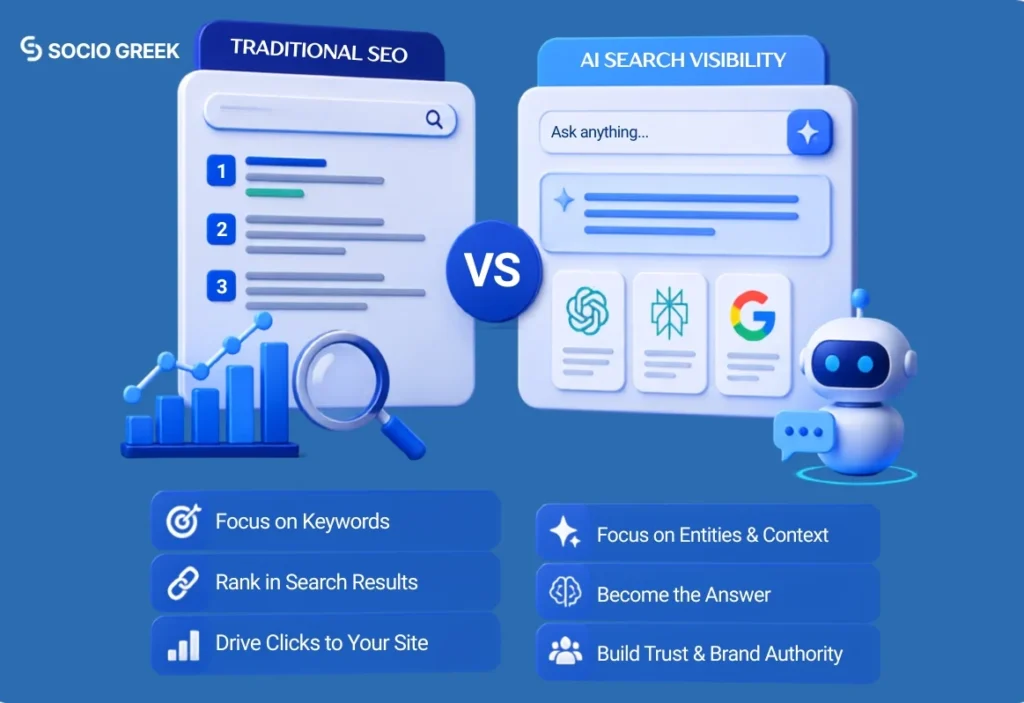
Traditional SEO is about ranking. AI search engine optimization is about being cited. Google, ChatGPT, and Perplexity don’t just index your page anymore – they extract specific sentences, statistics, and definitions from it to build an answer. If your content isn’t structured in a way that’s easy to lift out and quote, an AI model will simply choose a competitor’s page instead.
That shift is exactly why so many businesses are now searching for how to increase AI visibility of website and looking for dedicated ai search engine optimization services rather than relying on old-school SEO tactics alone. At Socio Greek, this is a big part of the conversations we now have with clients. AI visibility has become just as important a goal as traditional rankings.
A Quick Snapshot: Old SEO vs. AI Search Optimization
Factor | Traditional SEO | AI Search Optimization (GEO/AEO) |
Goal | Rank on page 1 | Get quoted inside the answer |
Success signal | Click-through rate | Citation frequency |
Content style | Long, keyword-dense | Clear, quotable, structured |
Key requirement | Backlinks | Backlinks + entity trust + freshness |
Crawlers to allow | Googlebot | GPTBot, PerplexityBot, ClaudeBot, Google-Extended, Bingbot |
Step 1: Make Sure AI Crawlers Can Actually Reach Your Site
This may seem like a simple one, but it’s the most frequent reason for websites not showing up in AI-generated answers. AI bots are automatically blocked by many security plugins and CDN firewalls.
Ensure that your Robots.txt doesn’t block
- GPTBot and OAI-SearchBot (OpenAI/ChatGPT)
- PerplexityBot (Perplexity)
- ClaudeBot (Anthropic)
- Google-Extended (Google’s AI features)
- Bingbot (Bing indirectly feeds several AI assistants)
Blocking these bots while trying to show up in AI search is the modern equivalent of blocking Googlebot and wondering why you don’t rank.
Step 2: Structure Content So It Can Be Extracted, Not Just Read
AI models don’t “enjoy” content the way humans do – they parse it. To optimize a website for AI search, write in a way that gives models clean, standalone chunks of information:
- Open each section with a direct answer, then explain further below it
- Do not use a vague pronoun such as it without context – be specific (this makes up for this…).
- Write descriptive, real questions H2/h3 headings.
- Do not use long paragraphs; instead, bullet point, number or use short tables.
- Make an FAQ section, heading with Q&A subheadings
A simple test many SEO professionals now use: read a paragraph in isolation, as if it were the only sentence pulled onto an “island” with no surrounding context. If it still makes sense on its own, it’s AI-friendly.
Step 3: Strengthen Entity Trust and Authority Signals
AI systems cross-check who is saying something before deciding whether to trust it. This is where entity consistency matters – your business name, address, author bios, and social profiles should match across your website, Google Business Profile, LinkedIn, and industry directories.
Practical ways to build this trust:
- Add clear author bylines with real credentials on blog content
- Consistency in NAP (Name, Address, Phone) online is key
- Get listed in third-party review sites, industry blogs and directories
- Schema markup (Organization, Article, FAQ, Product): Use schema markup to tell machines that there is a fact.
- Share original data or first-hand information instead of copy-and-pasted information from other sources.
Step 4: Keep Content Fresh – AI Engines Reward Recency
Newer sources are preferred over articles that are, say, 10 years old, especially with regard to perplexity. It’s far more likely that a page with the current statistics and a visible date/modified timestamp will be cited, even if the outdated page used to be ranked high on Google.
Quick freshness checklist:
- Update statistics and examples at least every few months
- Refresh the published/modified date in your page’s schema
- Remove or rewrite claims that are no longer accurate
- Add recent case studies or real numbers wherever possible
Step 5: Don’t Ignore Google’s AI Overviews
While ChatGPT and Perplexity get most of the conversation, optimizing your website for generative AI features on Google Search deserves equal attention, since AI Overviews now appear above traditional results for a huge share of queries. The same principles apply – clear structure, strong schema, credible sourcing – but Google also weighs your existing domain authority and Core Web Vitals more heavily than the newer AI-native engines do.
Measuring Your AI Search Visibility
There is currently no single dashboard for AI citations as there is for Google Search Console, but you can track progress by:
- Spending time each month asking the same questions over and over again to ChatGPT, Perplexity, and Gemini
- Tracking referrals from ai.chatgpt.com, perplexity.ai, and other sources in your analytics.
- Using a mention-monitoring tool to monitor brand mentions across the web.
- Noting how often your exact statistics or phrasing appear in AI-generated answers
Most businesses that implement these changes properly start noticing citation improvements within 60-90 days, with fuller results building over four to six months as authority signals compound.
Impact of Website Development on AI Search Visibility
A lot of this comes down to how your website is actually built – its technical structure, schema implementation, page speed, and content architecture all affect whether AI crawlers can read and trust it in the first place. This is exactly the kind of foundational work our team handles at Socio Greek, where we build and restructure websites specifically to support both traditional SEO and modern ai search visibility goals from the ground up. When your site’s already built to the point of hindering its visibility to AI, a development audit is often the quickest method for discovering why.
Final Thoughts
AI search visibility isn’t a passing trend – it’s becoming a core channel alongside Google rankings. Flexible businesses that let appropriate crawlers index them, structure content to be easily extracted, and establish a real presence will naturally be the preferred choices in the future over those that haven’t gotten ready. Those that aren’t, they will remain invisible, regardless of how impressively they might perform on paper with traditional SEO.
Get started: Audit your robots.txt this week, restructure your top 10 pages with the island test and add schema when required.